
Reduce AI Costs Without Sacrificing Performance
As generative AI moves into production, usage and costs can grow quickly across teams, applications, models and providers.
Stratosphere Networks helps organizations assess AI usage and identify solutions that reduce unnecessary LLM costs while maintaining the performance, security and output quality each use case requires.
Requests are evaluated and routed before reaching an AI provider
AI Spending Can Become Difficult to Control
AI costs are often distributed across departments, platforms, development teams and individual applications. Without centralized visibility, organizations can struggle to understand where money is being spent and why.
- Which teams and applications generate the most AI spend?
- Are premium models being used for simple tasks?
- How many tokens are being consumed?
- Are repeated prompts and documents being processed unnecessarily?
- Are budgets and usage limits being enforced?
Without better visibility and controls, AI spending can become harder to predict as adoption grows.
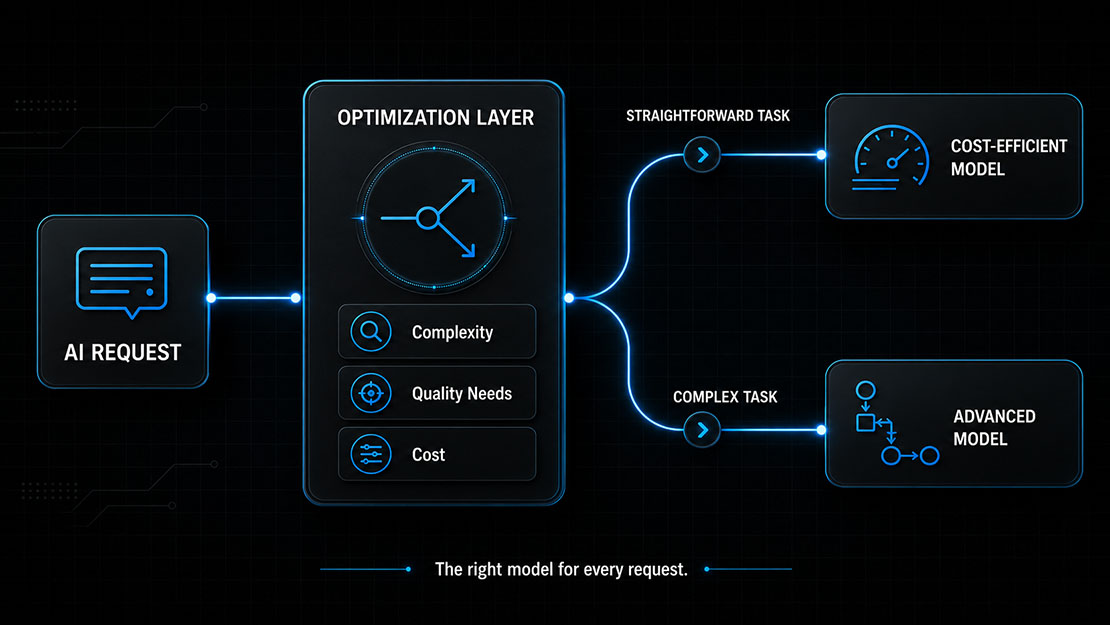
Optimize Every AI Request
Use the Right Model for the Right Task
AI optimization solutions can evaluate requests before they reach an AI model. Based on the workload, requests can be routed to a model that balances cost, performance and quality.
This allows organizations to use advanced models when needed without paying premium-model costs for every request.
Four Ways to Reduce LLM Costs
Intelligent Model Routing
Route requests to the most cost-effective model capable of meeting the workload's requirements.
Business impact: Reduce unnecessary premium-model usage.
Token Optimization
Reduce unnecessary instructions, duplicate context and other content that increases token consumption without improving results.
Business impact: Lower per-request costs while preserving useful context.
Prompt and Context Caching
Reuse eligible prompts, documents and background information instead of processing the same content repeatedly.
Business impact: Reduce repeated processing costs and improve response times.
Model Usage Analysis
Identify workloads using more model capacity than required and evaluate more cost-effective alternatives.
Business impact: Find optimization opportunities across existing AI applications.
Visibility Into Every AI Dollar
Cost optimization also requires clear visibility into how AI resources are being consumed. Technology, finance and FinOps teams need usage data they can connect to budgets, applications and business initiatives.
Organizations Can Track
- Spend by department, team or business unit
- Usage by application, project or customer
- Costs by provider and model
- Token consumption and request volume
- Budget performance and projected overages
- Unusual usage or spending spikes
This information can support budgeting, internal chargebacks, ROI reporting and more informed AI investment decisions.
Establish Guardrails Before Costs Escalate
Budget Controls
Set spending thresholds by team, project, application or account.
Usage Alerts
Notify stakeholders when usage or spending approaches established limits.
Rate Limits
Prevent applications, testing environments or automated workflows from generating uncontrolled usage.
Access Governance
Control access to AI services and manage credentials centrally.
Support AI, Agentic Workflows and Enterprise Applications
AI cost optimization can be applied across many enterprise workloads, with routing and controls adjusted based on performance, privacy, quality and reliability requirements.
Benefits Across the Organization
CIOs and Technology Leaders
- Control AI costs as adoption expands
- Create a consistent optimization strategy
- Connect AI spending to business outcomes
Engineering and AI Teams
- Improve efficiency without redesigning every application
- Maintain access to multiple AI providers
- Monitor cost, quality and performance
Finance and FinOps Teams
- Attribute spending to teams and projects
- Establish budgets and usage policies
- Improve forecasting and ROI reporting
Our AI Cost Optimization Process
1. Discover
Inventory AI providers, applications, models, workflows and current spending.
2. Analyze
Identify expensive workloads, repeated requests, inefficient model usage and missing cost controls.
3. Compare
Evaluate AI optimization and gateway solutions based on cost, security, compatibility and governance requirements.
4. Optimize
Implement the selected approach, establish controls and monitor usage and results.
Find the Right Solution—Not Just a Less Expensive Model
AI cost reduction should not come at the expense of output quality, reliability, security or user experience.
Stratosphere Networks helps organizations evaluate optimization technologies and providers based on their actual AI environment. Our advisors can compare capabilities and help identify an approach that balances cost, performance and business requirements.
Start an AI Cost Assessment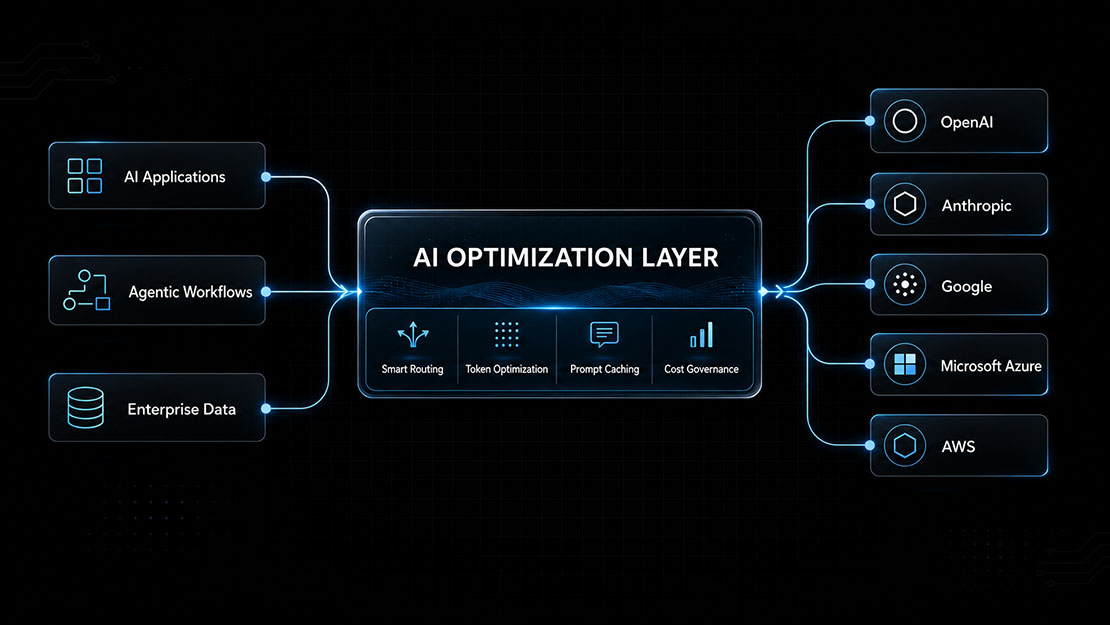
Make Every AI Request More Cost-Effective
Understand where your AI budget is going, identify unnecessary spending, and create a scalable approach to AI cost management.
Frequently Asked Questions About AI & LLM Cost Optimization
LLM cost optimization is the process of reducing the cost of operating AI applications. It can include model routing, prompt compression, context caching, token management, usage monitoring and budget controls.
Not necessarily. The goal is to match each request with a model capable of meeting its requirements. Straightforward tasks may not require the same model capacity as complex reasoning, analysis or decision-support workloads.
Yes. Many AI gateway and optimization solutions support multiple providers, allowing applications to use different models based on cost, capability, availability and policy requirements.
It depends on the selected solution and the existing architecture. Some optimization platforms can be introduced through an AI gateway or API-compatible layer with relatively limited application changes.
Savings depend on existing usage patterns, model selection, prompt size, request repetition and the controls already in place. An assessment is the best way to estimate potential savings without making unrealistic assumptions.
They overlap, but they are not identical. Cost optimization focuses primarily on efficient resource use and financial control. AI governance also addresses security, access, compliance, risk, approved use cases and organizational policy.